History
A Town Between River and Sea
Centuries of history where the Mira meets the Atlantic
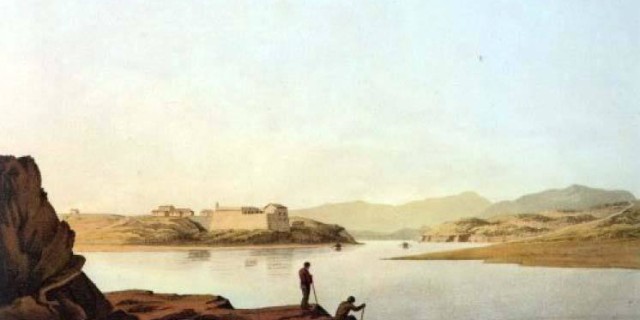
1818 engraving by George Landmann depicting the mouth of the River Mira, with the Fort of São Clemente and the settlement of Villa Nova de Milfontes at the centre.
Source: History Archive
Vila Nova de Milfontes rises on the right bank of the River Mira, where its waters meet the Atlantic. This place, for centuries a crossroads between land and sea, served as a Roman port, a fortress against corsairs, and a fishermen's haven. Its history is that of a small town that has preserved the memory of every era, from the megalithic age to the present.
A little bit of the history of Milfontes
The banks of the River Mira have been the scene of human presence since the Paleolithic era. This fact is proven by the presence of numerous archaeological remains in the area. Chipped stone instruments are known, probably made by Homo Erectus, which are more than half a million years old.
During the Roman occupation of Hispania, the area was also the target of occupation. There are several archaeological remains, which require further study. During the construction of the bridge over the Mira, several ceramic fragments were discovered, which, unfortunately, were badly damaged during removal. Shortly after this event, a Roman anchor block was also recovered from the seabed, in the Barra area.
There are few material remains from the period of Muslim rule. This presence became more pronounced in toponyms that still persist today, of which Odemira and Almograve are examples. During the last phase of Reconquista, at the beginning of the 13th century, the border between the declining Islamic civilization and the Christian advances was temporarily fixed north of the River Mira.
At the end of the Christian reconquest, the Alentejo coast was a sparsely populated territory with serious organizational needs, as such, the King of Portugal D. Afonso III made large donations to the Order of Santiago as a reward for its important role in the war against the Moors. In 1486, D. João II founded a new town, in a place called Milfontes, with the purpose of protecting and developing commercial transactions. It detached its territory from the municipality of Sines, to which it previously belonged, and thus created a new municipality that lasted between 1486 and 1836.
As it is located on the coast, this region was frequently attacked by pirates, who pillaged and robbed the population and vessels. In the 16th to 18th centuries, the Maghrebian corso afflicted the Portuguese coasts in a dramatic way. To combat this climate of fear and instability, at the end of the 16th century, the São Clemente fort (Milfontes Castle) was built.
Vila Nova de Milfontes was a small fishing village and as a municipality seat it was never an attractive center (in 1801 it had only 1559 inhabitants), losing this title in 1836 when it was integrated into the municipality of Cercal do Alentejo and later (1855) into that of Odemira to which it still belongs today.
This location is linked to the great feat of Portuguese aviation, which was the first aerial crossing between Portugal and Macau, carried out by Brito Paes and Sarmento Beires. It was on April 7, 1924 that the pilots left Campo dos Coitos, near Milfontes, heading towards the East. In honor of the aviators and their historic feat, a monument was erected in Praça da Barbacã, next to the fort, commemorating the heroic journey.
The origin of the name
Before being Vila Nova de Milfontes, the town was just “Milfontes”. This must be a medieval toponym, which would serve to identify the entire right bank of the River Mira. "Thousand" does not actually correspond to an exact number, in reality designating a large quantity, an indeterminate number. "Fonts" refers to springs existing in the region. This means that "Milfontes" was a region of abundant water. Founded in 1846, with the name "Milfontes", the town "gained" its current name a few years later. The term "Vila Nova de Milfontes" appears in documentation dated 1500, and the use of the new expression was intended to describe a recently built town.
Bibliography:
Quaresma, António M. (1988). Historical Note about Vila Nova de Milfontes. 2nd Edition.
Official Website of the Odemira City Council